
Global Health
Building Tesfa: An AI Platform Predicting Health Risks in Conflict-Affected East Africa
When post-conflict regions like Ethiopia's Tigray lack the real-time data to anticipate emerging health risks, we built Tesfa, an agentic AI platform that turns fragmented conflict and health data into forward-looking risk predictions for NGOs.
Introduction
Post-conflict regions face a specific data problem: health systems are fragmented, environmental hazards linger long after fighting stops, and the organizations responding are reacting to crises rather than anticipating them. Tesfa was built to close that gap.
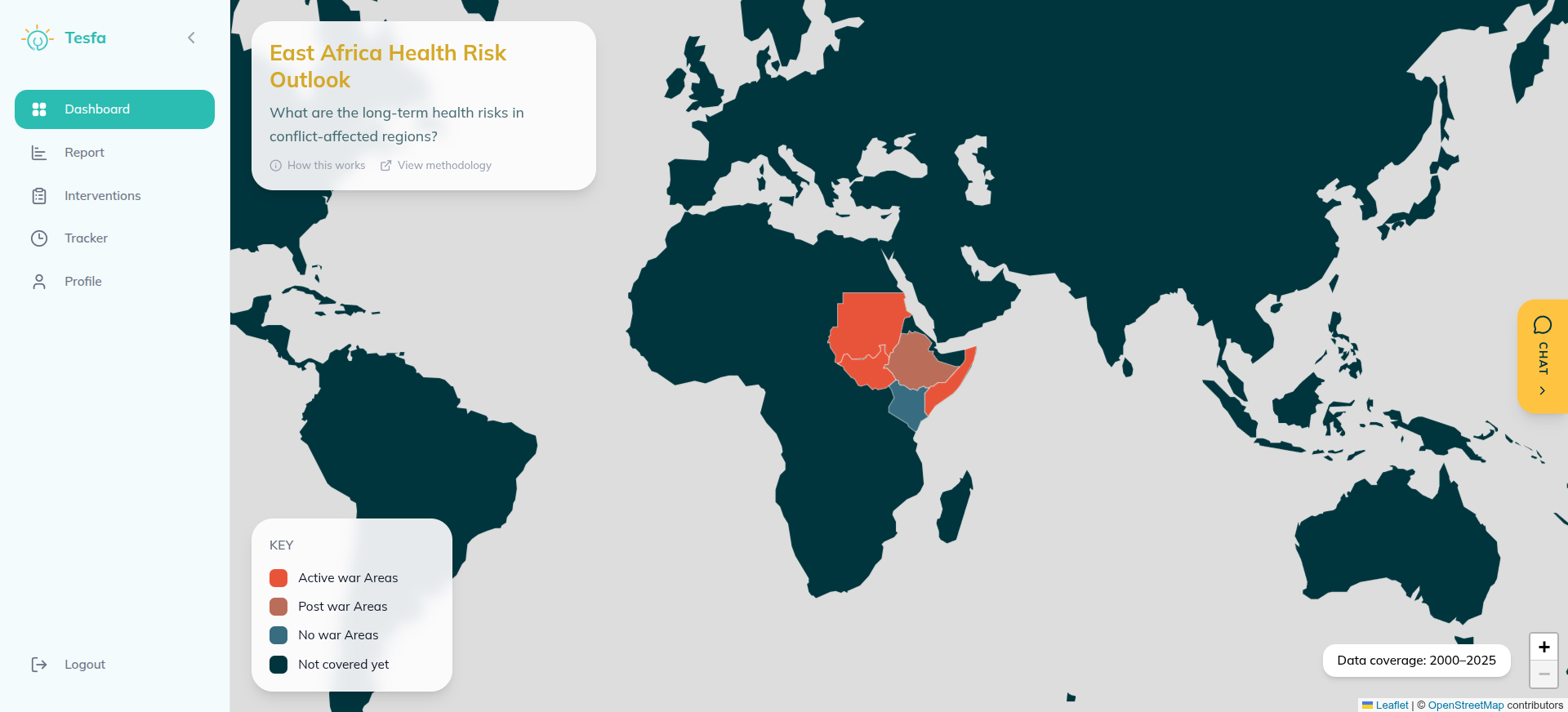
Tesfa started as a focused study of the aftermath of the war in Ethiopia's Tigray region, where destroyed healthcare infrastructure, unexploded ordnance, and chemical contamination continue to drive up rates of infectious disease, chronic illness, and mental health conditions. It has since grown into a platform covering five East African countries, using a retrieval-augmented AI pipeline to generate health risk predictions grounded in real documented data rather than model guesswork.
Tesfa is still an active, evolving project, a proof of concept for how AI can support humanitarian decision-making in low-data environments.
Problem Description and Context
Armed conflict doesn't just cause immediate casualties; it triggers long cascades of health risk that can take years to fully surface. In Tigray, the destruction of healthcare facilities, contamination from unexploded ordnance and chemical remnants, and the collapse of sanitation systems created conditions for both infectious disease outbreaks and long-term chronic illness. Research from comparable post-conflict settings in Syria, Iraq, and postwar Japan shows the same pattern: resurgent vaccine-preventable diseases, elevated cancer and respiratory illness rates from pollutant exposure, and persistent mental health burden among civilians and healthcare workers.
The core failure isn't a lack of research. Real-time, localized data is scarce in conflict-affected areas, and no integrated tool existed to combine environmental, health, and social data into an early-warning system NGOs could act on. Without that, resource allocation stays reactive: organizations respond to outbreaks after they've already taken hold, rather than directing mine clearance, pollution cleanup, or vaccination campaigns to the areas most likely to need them next.
Our Approach
The team paired desk research with direct field research in Tigray: 190 survey respondents and 26 in-depth interviews with engineers, medical doctors, and researchers working in the region. This grounded the platform in what was actually happening on the ground, not just what the literature predicted.
Several modeling approaches were evaluated for the AI layer, including BioGPT, SciBERT, BioMedLM, and GeoLLM, alongside a Random Forest model to complement unstructured-text analysis with structured tabular data. BioGPT was chosen for its biomedical specialization and strength in extracting relationships from unstructured, incomplete conflict-health text, the kind of material available from field reports and academic literature, rather than clean structured datasets.
The Technology
Tesfa uses a Retrieval-Augmented Generation (RAG) architecture so predictions are grounded in real conflict-health data rather than a model's general training knowledge:
- Frontend: Next.js 15, Tailwind CSS, Leaflet (interactive maps), Recharts
- Backend: Django, Django REST Framework, PostgreSQL
- AI pipeline: BioGPT for retrieval, Ollama (gemma3:27b) for generation, orchestrated via LiteLLM
- Vector storage: Supabase with the pgvector extension, with roughly 105,000 document embeddings drawn from conflict-affected regions worldwide (East Africa, the Middle East, and Central Africa)
- Deployment: AWS EC2, PM2, Nginx
The prediction pipeline runs in six steps: a query is formed for a specific country or region; BioGPT retrieves relevant documents from the vector database; the retrieved context and query are passed to gemma3:27b, which generates a structured prediction (disease risks, risk scores, risk levels, and recommended interventions); the output is validated and stored; predictions are served via the Django REST API to a map dashboard and chat interface; and the AI can synthesize predictions across all covered countries into a full Health Risk Analysis Report.
Coverage currently spans five countries: Sudan, Ethiopia, South Sudan, Somalia, and Kenya, with data drawn from WHO health bulletins, UNHCR displacement data, conflict health surveillance records, academic research (2000-2025), and OCHA humanitarian cluster reports.
How It Works
Picture Mesfin, an ICRC field officer restoring health services in a post-conflict region. He doesn't know exactly who needs what, where, or why certain risks are emerging; the data he'd need to know that is scattered, outdated, or missing. Here's what happens when he uses Tesfa.
He opens the map. Tesfa's dashboard shows color-coded regions by health risk level. Hovering over a country surfaces current predictions and likely disease outbreaks; zooming into a specific region, say Tigray, shows the same detail at a sub-national level.
He asks a follow-up question. If a prediction raises a question the summary doesn't answer, such as "Why is cholera high in this region?", Mesfin can ask directly through the chat interface and get a context-aware explanation, not just a static number.
Behind the scenes, an AI agent is doing the reasoning. When Mesfin's question comes in, it goes to the Tesfa AI agent, built on Ollama (gemma3:27b), which acts as the orchestrator: it interprets the question, decides which tools to call, and assembles the final answer. First, a retrieval tool searches Tesfa's Supabase vector database for relevant context using semantic search; if the database doesn't have enough, the agent falls back to a live web search via DuckDuckGo. Once it has context, it calls a second tool, a BioGPT-based prediction model, to analyze that text and generate the actual health risk assessment. Ollama (gemma3:27b) then returns the result as natural language or structured JSON, depending on what's needed.
Detected risks are turned into prioritized, trackable tasks so predictions don't just sit on a dashboard; they translate into coordinated field action, with status tracking (pending, in progress, and completed).
The Health Risk Analysis Report
Beyond the interactive dashboard, Tesfa can generate a full Health Risk Analysis Report synthesizing predictions across every country and region it covers. In its current form, the report includes:
- An executive summary of the crisis picture across assessed countries
- Key statistics: countries and regions assessed, and active conflicts versus post-war status
- Comparative charts: average risk score by country, risk level distribution, and the most prevalent diseases region-wide
- Country-by-country and region-by-region breakdowns, each with its own risk chart and narrative context
- Concrete recommendations tied to the data, such as prioritizing malaria control where scores exceed 90% or flagging where WASH interventions are most urgent
Every report carries a clear AI disclaimer: predictions are indicative, not a replacement for expert medical or humanitarian judgment, and should be validated against local data.
What Tesfa Demonstrates
- A working RAG pipeline that grounds AI predictions in approximately 105,000 real documents rather than model speculation
- Prediction coverage across five active and post-conflict countries
- A full path from raw conflict-health data to an actionable, region-specific risk report
What's Next
Tesfa is still active and being iterated on. The roadmap includes expanding coverage to more countries and broadening the platform beyond health-risk prediction alone, toward a wider range of questions the same underlying pipeline can be applied to.
See Tesfa in action. Get in touch with us if you'd like a Tesfa demo.